
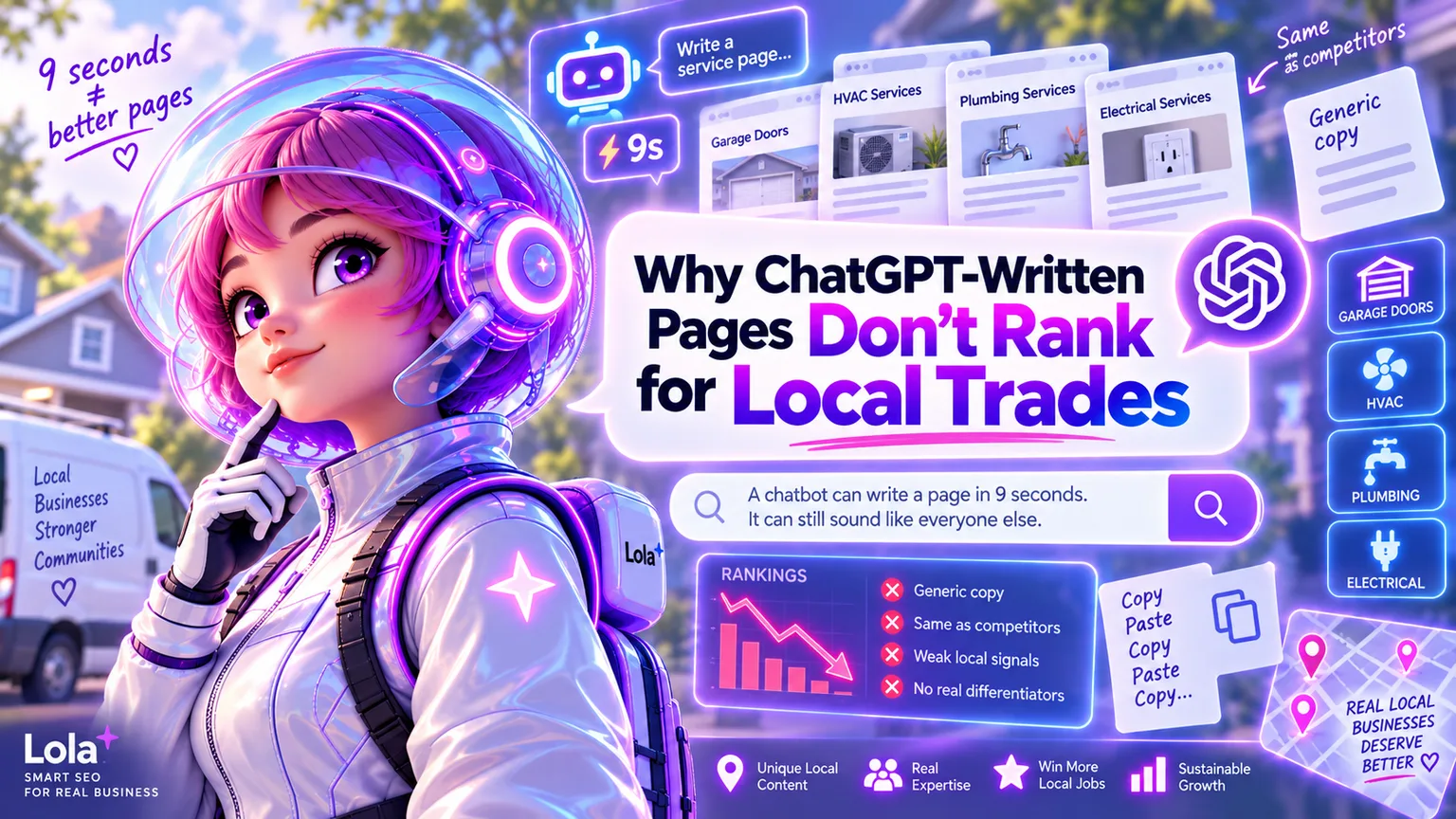
Open ChatGPT and type "write a service page for a water heater repair company in Katy, Texas." In about nine seconds you will have something that looks finished. It has a headline, a few paragraphs, a list of benefits and a call to action. It is grammatically perfect.
Now ask it again with "Sugar Land" instead of "Katy." Then ask for a competitor's company name. Read the three side by side. They are the same page. Change the name and the town and nothing else moves.
That is the problem in one exercise.
Why the output is so generic
A general chatbot learned about SEO the same way it learned about everything else: by reading a huge amount of text, including a lot of articles about SEO. It knows what a service page usually sounds like. What it does not know is anything about your business, and it has no way to know which pages actually ranked and which ones sank.
So it does the only thing it can. It writes the average of every service page it has seen. The average is, by definition, what everyone else already has.
The swap-the-name test
Here is a quick way to judge any page on your site, whoever wrote it. Replace your company name and city with a competitor's. If the page still makes sense, it is not really about you.
Generic phrases fail the test instantly:
- "We pride ourselves on quality workmanship."
- "Our team of experienced professionals."
- "Fast, reliable service you can count on."
Specific facts pass it:
- "Luis has installed tankless units on 60 homes in Cinco Ranch since 2021."
- "We stock Rheem and Bradford White tanks on the truck, so most replacements are same day."
- "Most of our Katy calls come from homes built in the early 2000s, when the original tanks are reaching the end of their life."
None of those sentences needed a talented writer. They needed information only the business has.
What Google does with pages like this
Google has said openly that it acts against content produced at scale mainly to rank, rather than to help people. It also rewards pages that show first-hand experience. A pile of near-identical city pages generated in an afternoon is exactly the pattern those policies describe.
Even when those pages avoid a penalty, they rarely win. When ten plumbers publish the same page, Google has no reason to prefer yours. It falls back on other signals, like reviews, links and your Google Business Profile, and your content contributes nothing.
It is not AI that is the problem
Being fair: AI is a very good writing tool. The issue is what it is fed and how it is steered. The same model that writes a bland page from a one-line prompt can write a strong one from a page of real facts about real jobs.
Two things make the difference.
The inputs. Your licenses, your crew, your equipment, your service history and your customers' real questions. Without these, any writer, human or machine, produces filler.
Knowing what works. Structure matters as much as words. Which page types to build, how to link them, what to put above the fold, how to mark up the page so search engines understand it, and when to publish. That knowledge comes from doing it and watching the results, not from reading about it.
How Lola is different from a chatbot
Lola was trained on more than 100 websites that were actually pushed to rank, with the results fed back, on top of years of our own agency's SEO work. She learned from outcomes, not from articles about SEO.
Then she interviews you, with more than 50 questions about your business, before writing anything. The training tells her what works in general. The interview tells her what is true for you. Neither is much use alone.
If you are writing with ChatGPT yourself
You can still get far better results from a general tool with a few habits:
- Give it facts first. Paste in real details: license numbers, crew names, brands you service, neighborhoods and job counts. Ask it to use only those facts.
- Ban the filler. Tell it not to use phrases like "quality workmanship" or "team of professionals."
- One city, one real story. If you cannot name a real job in a town, do not build a page for that town yet.
- Read it out loud. If it does not sound like something you would say to a customer on the phone, rewrite it.
- Run the swap test before you publish anything.
The nine-second page is not free. It costs you the chance to say something your competitors cannot.